
What Soldiers Do: A Comprehensive Overview

Soldiers dedicate themselves to defending national interests, upholding peace, and providing humanitarian aid, as detailed in comprehensive guides like FM 7-21.13.
Resources such as the Soldier’s Guide and STP 21-1-SMCT offer insights into training, duties, and the core responsibilities inherent in military service.
These manuals, available through platforms like the Internet Archive, cover everything from basic skills to complex operational procedures, ensuring readiness and competence.
The Soldier’s Manual of Common Tasks, specifically Skill Level 1, focuses on foundational warrior skills essential for every service member’s initial development and success.
The role of a soldier is multifaceted, extending far beyond traditional combat. Soldiers are citizens first, entrusted with the immense responsibility of safeguarding national security and global stability. Comprehensive resources, like the U.S. Army’s Soldier’s Guide (FM 7-21.13), detail the historical context and evolving nature of this vital profession.
Initially, a soldier’s journey begins with rigorous training, encompassing physical conditioning, weapons proficiency, and adherence to strict military standards. These foundational elements, outlined in publications like STP 21-1-SMCT (Soldier’s Manual of Common Tasks), prepare individuals for diverse operational environments.
Soldiers may be deployed in combat zones, participate in peacekeeping operations, or contribute to humanitarian missions, demanding adaptability and unwavering dedication. The Internet Archive provides access to these essential manuals, offering a glimpse into the comprehensive preparation and ongoing development required of every soldier, ensuring they are ready to serve.
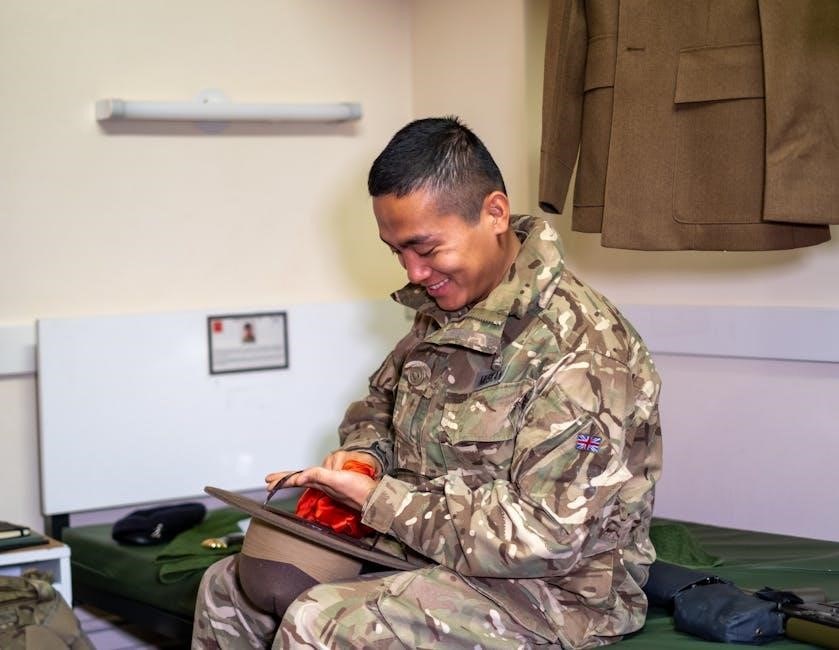
Core Responsibilities and Duties
Soldiers fulfill duties ranging from combat readiness to peacekeeping, guided by manuals like FM 7-21.13 and STP 21-1-SMCT, ensuring mission success.
These responsibilities encompass upholding standards, mastering skills, and adapting to diverse operational scenarios, as detailed in available resources;
Basic Training and Initial Entry
Initial entry into the U.S. Army begins with a rigorous basic training phase, foundational for all soldiers, as outlined in resources like FM 7-21.13 and STP 21-1-SMCT.
This immersive experience transforms civilians into soldiers, emphasizing discipline, teamwork, and adherence to military standards. Recruits undergo intense physical conditioning, weapons familiarization, and classroom instruction covering core soldier skills.
Basic training focuses on instilling the Army Values – loyalty, duty, respect, selfless service, honor, integrity, and personal courage – shaping character and building a strong moral compass.
The curriculum includes drill and ceremony, land navigation, first aid, and an introduction to combat tactics, preparing soldiers for diverse operational environments. Successful completion of basic training marks a crucial step towards a military career, paving the way for specialized training and deployment.
These initial stages, documented in the Soldier’s Guide, are vital for establishing the bedrock of competence and professionalism.
Physical Fitness and Conditioning
Physical fitness is paramount for soldiers, directly impacting mission effectiveness and survivability, as emphasized in Army manuals like FM 7-21.13 and STP 21-1-SMCT.
A comprehensive conditioning program focuses on building strength, endurance, agility, and resilience. Regular physical training (PT) sessions incorporate cardiovascular exercises, calisthenics, and weightlifting, tailored to meet the demands of military service.
Soldiers are evaluated on their physical capabilities through the Army Combat Fitness Test (ACFT), assessing muscular strength, power, speed, agility, and aerobic endurance.
Maintaining peak physical condition is not merely about passing a test; it’s about ensuring soldiers can perform demanding tasks, carry heavy loads, and withstand the rigors of prolonged operations.
The Soldier’s Guide details the importance of consistent training and proper nutrition, reinforcing a culture of fitness throughout the ranks, vital for operational readiness.
Weapons Training and Proficiency
Weapons training is a cornerstone of a soldier’s preparation, ensuring competence and confidence in utilizing various firearms and weapon systems, as detailed in resources like FM 7-21.13.
Initial training covers basic marksmanship principles, weapon handling, safety procedures, and maintenance. Soldiers learn to disassemble, assemble, and properly clean their assigned weapons.
Proficiency is honed through regular practice, including live-fire exercises and simulated combat scenarios. Training progresses to more advanced techniques, such as shooting from different positions and under stress;
Soldiers become proficient with a range of weapons, including rifles, pistols, machine guns, and grenade launchers, adapting to diverse operational environments;
The Soldier’s Manual of Common Tasks (STP 21-1-SMCT) reinforces these skills, emphasizing the critical importance of accuracy, speed, and responsible weapon handling for mission success and safety.
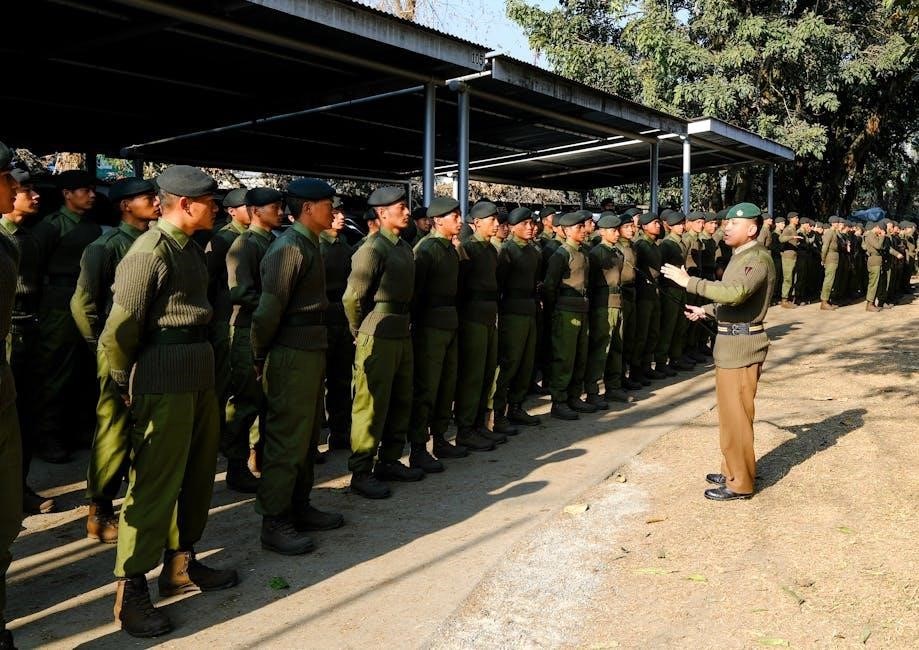
Operational Roles and Deployments
Soldiers fulfill diverse roles, from combat operations and peacekeeping to humanitarian missions, requiring adaptability and skill as outlined in manuals like FM 7-21.13.
Deployments can range from short-term training exercises to extended operations in challenging environments, demanding resilience and dedication to duty.
These roles necessitate proficiency in tactics, intelligence gathering, and collaboration, ensuring mission success and the safety of fellow service members.
Combat Operations and Tactics
Combat operations demand rigorous training and adherence to established tactics, as detailed within resources like FM 7-21.13, The Soldier’s Guide. Soldiers must master individual skills – weapon proficiency, movement techniques, and battlefield communication – to function effectively as a cohesive unit.
Tactical proficiency encompasses understanding terrain, utilizing cover and concealment, and executing coordinated maneuvers. Soldiers learn to adapt to dynamic situations, employing offensive and defensive strategies based on mission objectives and enemy actions.
Effective communication, utilizing established protocols, is paramount for maintaining situational awareness and coordinating fire support. The Soldier’s Manual of Common Tasks (STP 21-1-SMCT) reinforces these foundational skills, preparing soldiers for the complexities of modern warfare. Success hinges on discipline, teamwork, and a commitment to achieving victory while minimizing casualties.
These operations require constant evaluation and adaptation, ensuring soldiers remain prepared for any contingency.
Peacekeeping and Humanitarian Missions
Soldiers frequently participate in peacekeeping operations and humanitarian missions, extending beyond traditional combat roles. These deployments require adaptability, cultural sensitivity, and a commitment to fostering stability in fragile regions, as outlined in comprehensive guides like FM 7-21.13.
Humanitarian aid efforts encompass providing medical assistance, distributing essential supplies, and supporting infrastructure development. Peacekeeping involves monitoring ceasefires, protecting civilians, and assisting with conflict resolution, demanding impartiality and adherence to international law.
The Soldier’s Manual of Common Tasks (STP 21-1-SMCT) equips soldiers with skills applicable to these scenarios, including first aid, communication, and basic engineering. Success relies on building rapport with local communities and collaborating with international organizations. These missions demonstrate the military’s versatility and commitment to global well-being.
Such operations often require navigating complex political landscapes and upholding ethical standards.
Military Intelligence Gathering
Soldiers play a crucial role in military intelligence gathering, providing commanders with vital information for informed decision-making. This encompasses a wide range of activities, from reconnaissance and surveillance to analyzing data and interpreting signals, as detailed in resources like FM 7-21.13.
Intelligence gathering involves collecting information about enemy forces, terrain, and potential threats. Soldiers utilize various tools and techniques, including human intelligence (HUMINT), signals intelligence (SIGINT), and imagery intelligence (IMINT).
The Soldier’s Manual of Common Tasks (STP 21-1-SMCT) covers essential skills like observation, reporting, and map reading, fundamental to effective intelligence collection. Accurate and timely intelligence is paramount for mission success and minimizing casualties.
Maintaining operational security and protecting sensitive information are also critical aspects of this demanding role.
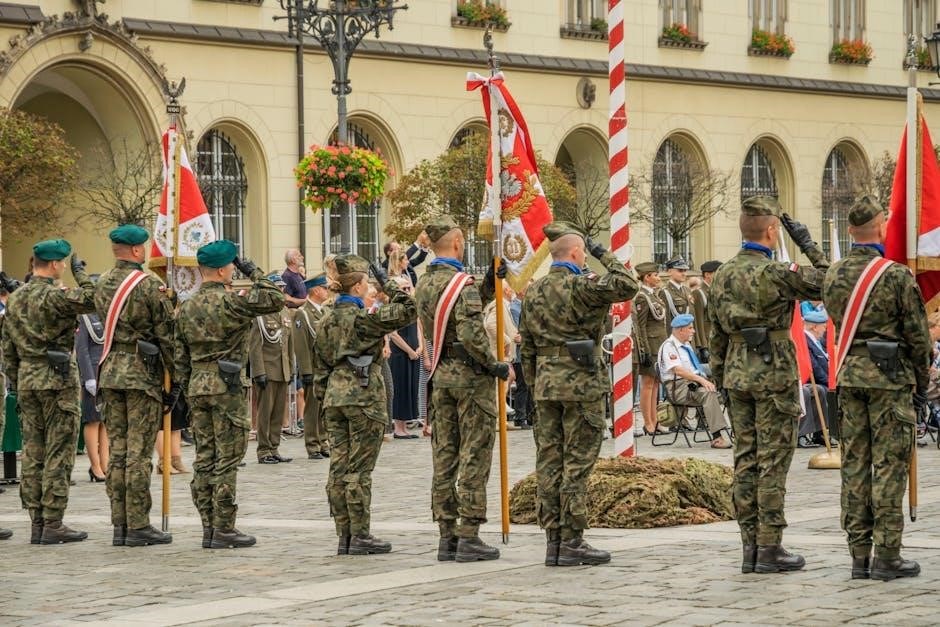
Essential Soldier Skills
Soldiers require diverse skills, including land navigation, communication, and first aid, as outlined in manuals like FM 7-21.13 and STP 21-1-SMCT.
Land Navigation and Map Reading
Proficiency in land navigation and map reading is absolutely critical for soldiers, enabling independent movement and mission success in diverse terrains. FM 7-21.13 and STP 21-1-SMCT emphasize these skills, detailing techniques for utilizing topographic maps, compasses, and GPS devices.
Soldiers must learn to interpret map symbols, determine their location, and plot courses, accounting for terrain features and obstacles. This includes understanding elevation, distance, and direction. Effective navigation isn’t simply about reaching a destination; it’s about maintaining situational awareness and avoiding becoming lost or disoriented.
Training encompasses both classroom instruction and practical field exercises, building confidence and competence. The ability to navigate accurately is fundamental to almost every military operation, from reconnaissance missions to large-scale deployments, ensuring soldiers can operate effectively even without relying on technology;
Communication Protocols and Procedures
Clear and concise communication is paramount within military operations, and soldiers are rigorously trained in established protocols and procedures. Resources like FM 7-21.13 and STP 21-1-SMCT detail standardized radio communication techniques, including phonetic alphabets and brevity codes, ensuring messages are understood accurately, even in high-stress environments.

Soldiers learn to use various communication devices, from handheld radios to secure satellite systems, understanding their capabilities and limitations. Effective communication extends beyond transmitting information; it involves active listening, acknowledging receipt, and maintaining radio discipline.
Proper procedures minimize interference, prevent security breaches, and facilitate coordinated action. Training emphasizes the importance of brevity, clarity, and accuracy, ensuring vital information reaches the intended recipients swiftly and reliably, contributing directly to mission success and soldier safety.
First Aid and Battlefield Medicine
Immediate medical intervention is critical in combat situations, and soldiers receive extensive training in first aid and battlefield medicine. Manuals like FM 7-21.13 and STP 21-1-SMCT outline procedures for treating a wide range of injuries, from minor wounds to life-threatening trauma, emphasizing the importance of self-aid and buddy-aid.

Soldiers learn to control bleeding, stabilize fractures, manage burns, and recognize the signs of shock. Training includes the application of tourniquets, wound dressings, and splints, alongside techniques for casualty evacuation. This knowledge empowers them to provide immediate care until professional medical help arrives.
Proficiency in battlefield medicine isn’t limited to medics; all soldiers are expected to possess basic life-saving skills, significantly increasing survival rates and demonstrating a commitment to the well-being of their comrades, vital for unit cohesion and mission effectiveness.
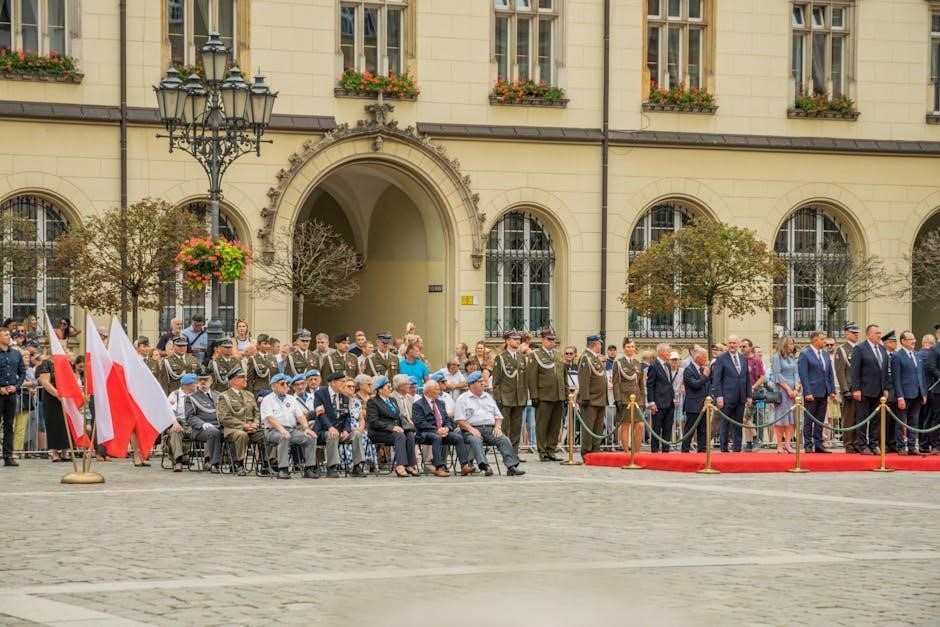
Army Traditions, Standards, and Conduct
Military customs and courtesies, detailed in resources like FM 7-21.13, foster discipline and respect, shaping a soldier’s conduct and upholding the Army’s core values.
Military Customs and Courtesies
Military customs and courtesies are the bedrock of discipline, respect, and unit cohesion within the Army, meticulously outlined in publications like FM 7-21.13 (The Soldier’s Guide). These aren’t merely formalities; they represent a deep-rooted tradition of honoring service, rank, and the profession of arms.
Proper salutes, addressing superiors correctly, and adhering to flag etiquette are fundamental examples, demonstrating respect for authority and the nation they represent. Understanding these customs extends to ceremonies, formations, and even everyday interactions, fostering a sense of camaraderie and professionalism.
The Soldier’s Guide emphasizes that observing these courtesies isn’t about blind obedience, but about recognizing the shared sacrifices and responsibilities inherent in military service. They contribute to a positive command climate and reinforce the values of loyalty, duty, respect, selfless service, honor, integrity, and personal courage.
Ultimately, mastering military customs and courtesies is integral to becoming a well-rounded and effective soldier, embodying the Army’s enduring standards of conduct.
Uniform and Appearance Regulations
Uniform and appearance regulations are critical components of military discipline and professionalism, comprehensively detailed within resources like FM 7-21.13 (The Soldier’s Guide). Maintaining a neat, clean, and standardized appearance reflects positively on the individual soldier, their unit, and the Army as a whole.
These regulations cover everything from proper wear of the uniform – including insignia, awards, and name tapes – to personal grooming standards, such as hairstyles, facial hair, and footwear. Adherence isn’t simply about aesthetics; it signifies attention to detail, respect for regulations, and unit pride.
The Soldier’s Guide stresses that consistent enforcement of these standards fosters discipline and cohesion. Deviations from regulations can undermine unit effectiveness and detract from the Army’s image. Soldiers are expected to understand and comply with these rules at all times, both on and off duty.
Ultimately, meticulous attention to uniform and appearance demonstrates a commitment to excellence and embodies the Army’s values.
Ethical Conduct and the Soldier’s Code
Ethical conduct forms the bedrock of trust within the military and between the Army and the public it serves, as emphasized in publications like FM 7-21.13 (The Soldier’s Guide). The Soldier’s Code demands unwavering integrity, honesty, and a commitment to doing what is right, even when no one is watching.
This code extends beyond simply following laws; it encompasses a moral compass guiding decisions in complex and challenging situations. Soldiers are expected to demonstrate respect for others, uphold the values of loyalty, selfless service, and courage, and to avoid any behavior that could bring discredit upon the Army.
The Soldier’s Guide highlights the importance of ethical decision-making in all aspects of military life, from interactions with civilians to conduct during combat operations. Maintaining high ethical standards is not merely a requirement, but a fundamental responsibility.
Upholding the Soldier’s Code ensures the Army maintains its reputation for honor and professionalism.
Soldier’s Manuals and Resources
FM 7-21.13 and STP 21-1-SMCT are vital resources, freely accessible via the Internet Archive, detailing Army traditions, training, and essential soldier duties.
Overview of FM 7-21.13 (The Soldier’s Guide)
FM 7-21.13, commonly known as “The Soldier’s Guide,” serves as a foundational manual for all U.S. Army personnel, providing a comprehensive overview of expectations and standards.
Published in various editions, including February and October 2003, and later updates, this guide details Army history, professional development, and crucial training elements.
It meticulously outlines standards for appearance and conduct, emphasizing the importance of discipline and adherence to military customs and courtesies.
Furthermore, FM 7-21.13 incorporates selected individual combat tasks deemed essential for every Soldier, ensuring a baseline level of proficiency in core skills.
Available through resources like the Internet Archive, this manual is a cornerstone of soldier education, promoting understanding of responsibilities and fostering a cohesive force.
The guide’s accessibility ensures all personnel have access to vital information regarding their roles and the Army’s overarching principles.
Understanding STP 21-1-SMCT (Soldier’s Manual of Common Tasks)
STP 21-1-SMCT, the Soldier’s Manual of Common Tasks, focuses on foundational skills crucial for initial entry and progression within the U.S. Army.
Specifically targeting Skill Level 1, this manual details the “warrior skills” necessary for all soldiers, providing a practical guide to essential tasks.
The 2017 and 2019 editions, published by Mentor Military and the U.S. Army, emphasize hands-on proficiency and standardized procedures.
It covers a range of competencies, preparing soldiers for diverse operational scenarios and ensuring a consistent level of competence across the force.
Available through platforms like Amazon.com and the Internet Archive, STP 21-1-SMCT is a vital resource for both recruits and experienced personnel.
This manual serves as a building block for advanced training, establishing a solid foundation for future military expertise and operational effectiveness.